Physical Address
304 North Cardinal St.
Dorchester Center, MA 02124
Physical Address
304 North Cardinal St.
Dorchester Center, MA 02124

Learn how to read a golf scorecard from scratch. Every column explained simply, so you always know what you are looking at.
You’re in the clubhouse. Someone slides a scorecard across the table. There’s a row of numbers, a column called “HCP,” another called “SI,” and a box at the bottom that says “Marker.” You nod like you get it.
You don’t get it.
That’s fine. Most golfers play for years before anyone actually explains what all those numbers mean. The course assumes you know. Your playing partners assume you know. Nobody explains it.
So here’s the full breakdown, plain and simple.
Every scorecard looks a little different depending on the course, but they all carry the same information. Once you understand the structure, you can pick up any scorecard anywhere in the country and know exactly what you’re looking at.
Here’s what you’ll find:
OUT / IN / TOTAL. Subtotals for the front nine, back nine, and full 18.
Hole numbers. 1 through 18, split into the front nine (holes 1 to 9) and back nine (holes 10 to 18).
Par. The number of strokes a scratch golfer is expected to take on each hole.
Yardage. The distance from the tee box to the hole, usually listed for multiple tee options.
Stroke Index (SI). Ranks holes by difficulty, from 1 (hardest) to 18 (easiest).
Score column. Where you write your strokes for each hole.
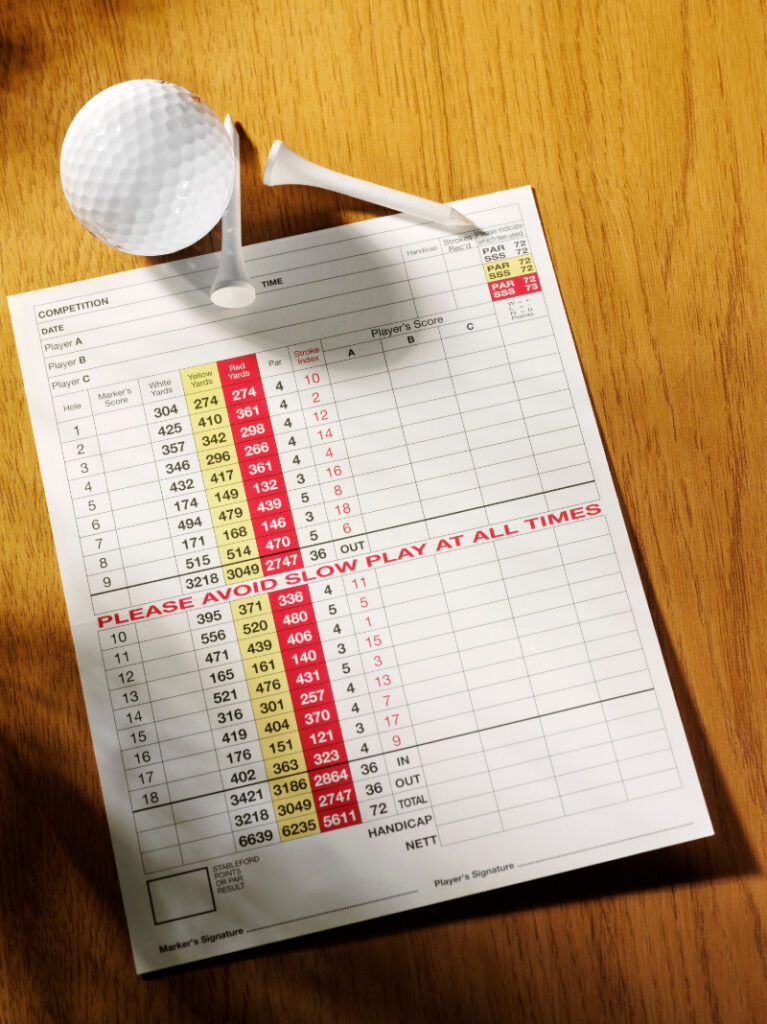
Before you even get to the first hole, the scorecard is already telling you something important: how far you’ll be playing.
Most courses have three to five sets of tees, each with a different color.
The scorecard shows the yardage for each tee on every hole. Pick the tees that match your game, not your ego. Playing from the wrong set doesn’t make you better. It just makes the round longer and more frustrating.

Par is the foundation of golf scoring.
Each hole has a par rating, usually 3, 4, or 5, which represents the number of strokes a scratch golfer is expected to take to complete it. A par 3 is a short hole. A par 5 is long. Par 4 is everything in between, and it’s the most common.
Add up all 18 holes and you get the course’s total par. Most courses sit at par 72. Some are 70, some are 73, but 72 is the standard across North America.
Here’s the scoring language you’ll hear on the course:
| Score on the hole | Name |
| 3 under par | Albatross (very rare) |
| 2 under par | Eagle |
| 1 under par | Birdie |
| Even with par | Par |
| 1 over par | Bogey |
| 2 over par | Double bogey |
| 3 over par | Triple bogey |
As a beginner, bogeys and double bogeys are completely normal. If you’re shooting mostly bogeys on every hole, you’re playing to about an 18 handicap. That’s solidly in the range of the average American recreational golfer.
This is where most beginners get confused. There are two scores: your gross and your net.
Your gross score is every stroke you took, added up, no adjustments. If you took 92 shots over 18 holes, your gross score is 92.
Your net score is your gross score minus your handicap. If you shot 92 and you have a 20 handicap, your net score is 72. That’s even par on most courses. That’s the number that lets golfers of different skill levels compete fairly against each other.
Here’s a real example. You shot 88. Your course handicap is 16. Your net score is 72. Your playing partner shot 80 with a handicap of 9. His net score is 71. He wins by one shot. Without handicaps, it wouldn’t even be a contest.
When you’re just starting out and don’t have an official handicap yet, you’ll mostly track your gross score to watch your progress over time.
The Stroke Index column is the one that trips people up the most.
Every hole on the course is ranked from 1 to 18 by difficulty. Stroke Index 1 is the hardest hole on the course. Stroke Index 18 is the easiest. This ranking decides which holes you get extra strokes on when playing with your handicap.
Here’s how it works in practice.
If your course handicap is 10, you get one extra stroke on the 10 hardest holes. Those are the holes with a Stroke Index of 1 through 10. On those holes, you subtract one from your gross score to get your net score for that hole.
If your course handicap is 20, you get one stroke on every hole, plus an extra stroke on the two hardest holes.
What to do on the course:
Flip the scorecard over, or look at the header, and you’ll usually see two numbers for each set of tees: Course Rating and Slope.
Course Rating is a number between roughly 67 and 77 that tells you how difficult the course is for a scratch golfer. The higher the number, the harder the course.
Slope Rating runs from 55 to 155, with 113 being the average. It measures how much harder the course is for a bogey golfer compared to a scratch golfer. A slope of 130 means the course is significantly tougher for higher handicappers than for low ones.
These two numbers feed into the USGA handicap system. They’re used to calculate your course handicap from your handicap index. You don’t need to do this math yourself. The GHIN app does it for you.
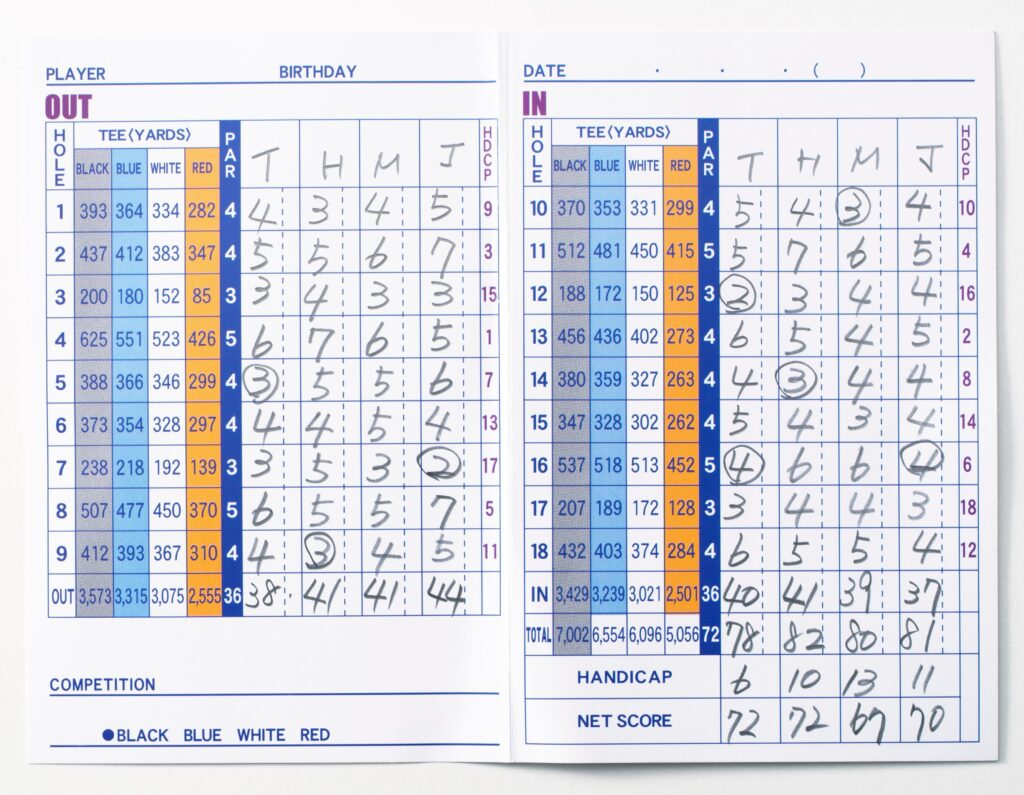
You’ve got the card, you’ve got a pencil. Here’s what to do:
One rule worth knowing: in competition, if you sign a scorecard with a lower score than you actually shot, you’re disqualified. If you sign with a higher score, that higher score stands. When in doubt, write what you actually took.
If you’re tracking your handicap through the GHIN system, there’s a concept called Net Double Bogey. It’s the maximum score you can record on a hole for handicap purposes.
It’s calculated as: Par plus 2, plus any handicap strokes you receive on that hole.
So on a par 4 where you get one handicap stroke, your max is 7. You write 7 on the card even if you took 9. This prevents one bad hole from completely wrecking your handicap calculation.
For casual rounds with friends, most golfers just pick up the ball after a double bogey and move on. That’s fine.
Every scorecard has a line at the bottom for the “marker.” This is the person in your group who is officially keeping your score.
In competitions, each golfer keeps score for another player, not for themselves. You check each other’s math, sign each other’s cards, and hand them in. It’s a system built on honesty, which is one of the things that makes golf different from most other sports.
In a casual Saturday round? Don’t worry about it. Keep your own score, trust your playing partners, and buy a beer for whoever had the best net score.
Once you understand the scorecard, the next step is getting an official USGA handicap. The GHIN app is the standard in the US. It tracks your scores, calculates your handicap index, and adjusts it after each round you post. It’s free, and most courses require it if you want to play in any club events.
Download it before your next round. Post your score after. Watch your handicap move. That’s the simplest way to measure real improvement over time.